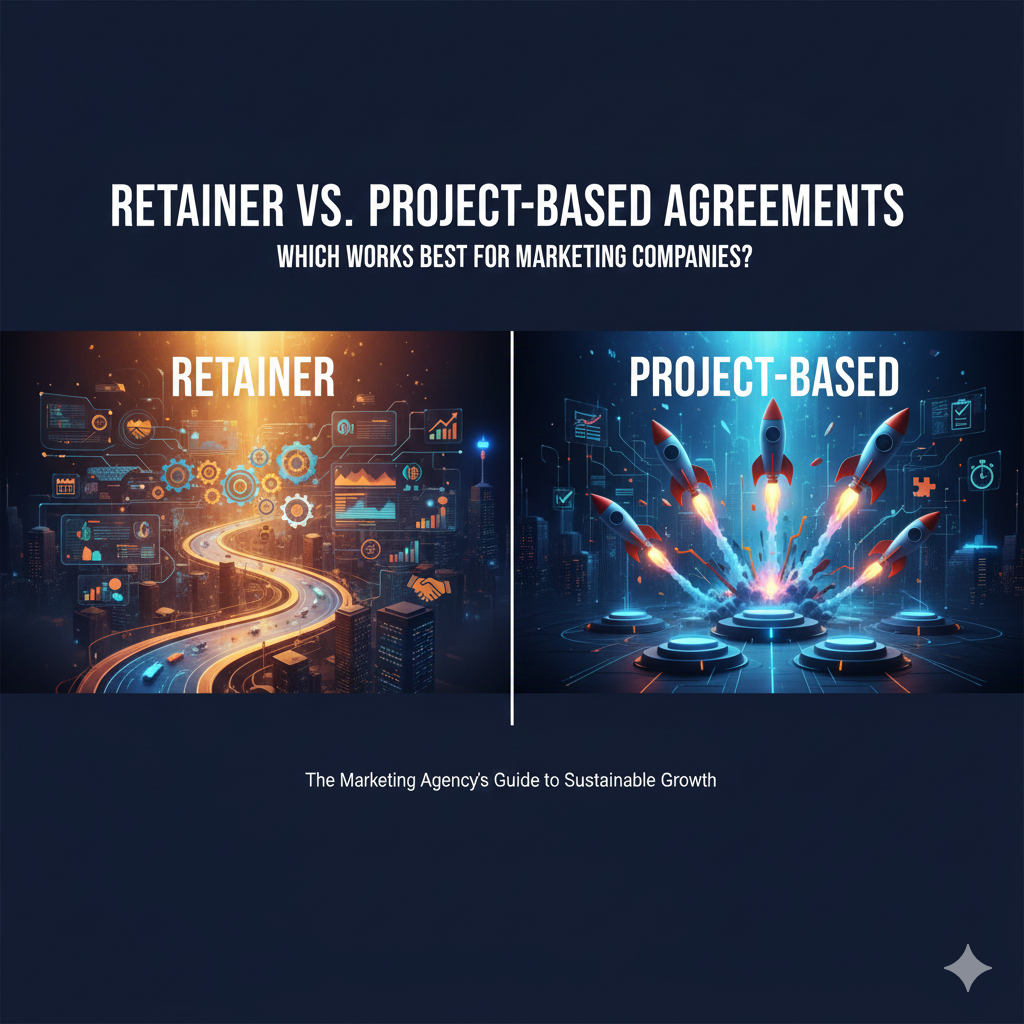
Marketing companies today operate in a fast-moving, results-driven environment where how you contract is just as important as what you deliver. Choosing between a retainer agreement and a project-based agreement can significantly impact revenue predictability, client relationships, team utilization, and legal risk.
This blog breaks down both engagement models, compares their advantages and drawbacks, and helps marketing companies decide which structure works best — or whether a hybrid approach is the smarter solution.
Understanding the Two Models
What Is a Retainer Agreement?
A retainer agreement is a long-term contractual arrangement where a client pays a fixed recurring fee (monthly or quarterly) in exchange for ongoing marketing services.
Typical use cases include:
-
Social media management
-
Performance marketing & ad optimization
-
SEO & content marketing
-
Brand strategy and advisory
-
Ongoing design and marketing support
The focus is on continuity and partnership, not one-time delivery.
What Is a Project-Based Agreement?
A project-based agreement is structured around a clearly defined scope, timeline, deliverables, and fee. Once the project is completed, the contractual relationship ends unless renewed.
Typical use cases include:
-
Website development or redesign
-
Campaign-specific marketing (product launches, events)
-
Brand identity creation
-
Marketing audits or strategy decks
The emphasis is on defined outcomes and closure.
Retainer Agreements: Pros & Cons for Marketing Companies
Advantages
1. Predictable Revenue
Retainers provide steady cash flow, making financial planning and resource allocation easier.
2. Stronger Client Relationships
Long-term engagements foster trust, deeper brand understanding, and better results over time.
3. Strategic Flexibility
Since the relationship is ongoing, teams can adapt strategies without renegotiating scope every time.
4. Lower Sales Effort
You don’t need to constantly pitch new work once the retainer is secured.
Challenges
1. Scope Creep Risk
Without clearly defined service boundaries, clients may expect unlimited work.
2. Underpricing Issues
If effort increases over time but fees remain static, profitability suffers.
3. Termination Sensitivity
Sudden termination can affect monthly revenue unless notice periods are well-drafted.
Project-Based Agreements: Pros & Cons for Marketing Companies
Advantages
1. Clear Scope & Deliverables
Defined expectations reduce misunderstandings and disputes.
2. Easier Client Onboarding
Clients hesitant about long-term commitments often prefer projects.
3. Better Cost Control
Effort, timelines, and budgets are easier to manage internally.
4. Ideal for Specialized Work
Perfect for creative, technical, or one-off assignments.
Challenges
1. Revenue Uncertainty
Once a project ends, income stops unless new work is secured.
2. Repeated Sales Cycles
Agencies must constantly pitch and close new projects.
3. Limited Strategic Depth
Short-term projects may not allow enough time to deliver transformational results.
Legal & Contractual Considerations
Key Clauses in Retainer Agreements
-
Scope of services (with exclusions)
-
Monthly deliverables or time allocation
-
Fee structure and payment timelines
-
Revision limits
-
Term, renewal, and termination notice
-
IP ownership and usage rights
Key Clauses in Project-Based Agreements
-
Detailed scope and milestones
-
Timelines and dependencies
-
Acceptance criteria
-
Change request mechanism
-
Payment milestones
-
Post-project support (if any)
A poorly drafted agreement — in either model — can convert a profitable engagement into a dispute.
Which Model Works Best for Marketing Companies?
Retainers Work Best When:
-
Services are ongoing and performance-driven
-
Strategy requires continuous optimization
-
The client values partnership over deliverables
-
The agency has strong process maturity
Project-Based Agreements Work Best When:
-
Work is outcome-specific and time-bound
-
Clients are new or untested
-
Budget certainty is critical
-
The scope can be clearly frozen
The Hybrid Model: A Practical Solution
Many successful marketing companies adopt a hybrid structure:
-
Project-based onboarding (strategy, brand setup, website)
-
Followed by a retainer for execution and optimization
This allows agencies to:
Final Thoughts
There is no universally “better” model — only a better-aligned one.
For marketing companies, the ideal choice depends on:
-
Nature of services
-
Client maturity
-
Revenue goals
-
Risk appetite
What matters most is clarity in scope, pricing, and legal drafting. A well-structured agreement doesn’t just protect your business — it enables growth.
If you’re revisiting your agency contracts, now is the right time to audit whether your engagement model truly supports scalability and sustainability.